‘Arry’s Bar

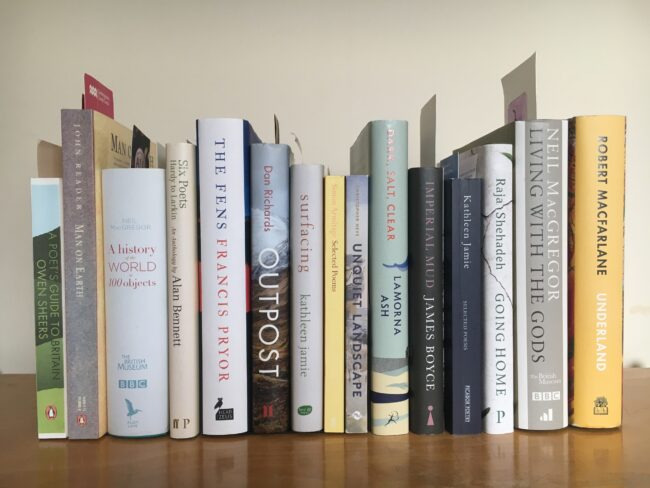
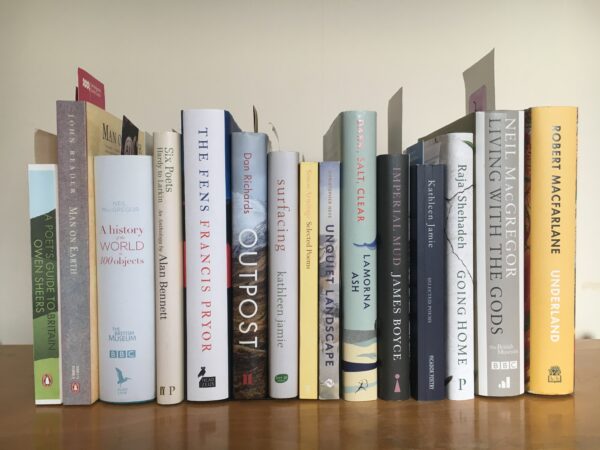
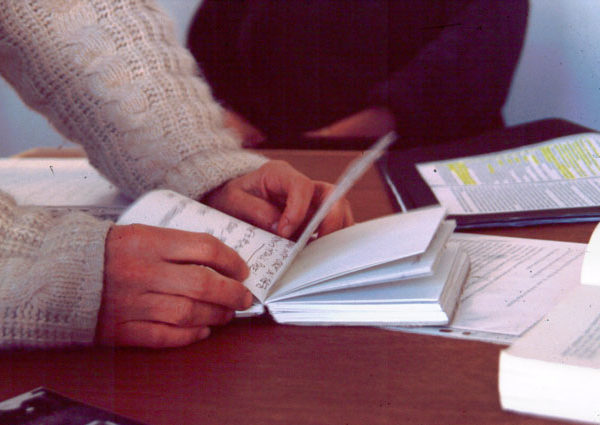
When her father dies, his daughter turns to his books for comfort. She finds 13 volumes, favourite books perhaps, that he had turned to for comfort when struggling with an unknown illness in his last months – unable to walk, to swallow, and finally to breathe. She had arrived home to visit him just as he was taken into hospital. He never returned. Now she finds herself sleeping in his bed, working in his study, reading his books – this last set of 13 positioned on a table at the doorway to his room. Each one is marked with a bookmark – some pre-made, some hand-made, and some just pieces of paper – marking time as he recorded his own life and history, marked his body breaking down. In her efforts to keep him alive, she reads and re-reads these notes inserted between pages, as fragments, passages unconnected, yet linked somehow, across the days and nights of mourning, pausing now and then …
For the first time perhaps, she finds herself unable (or is it unwilling?) to write, not wishing to turn his death, and her mourning, into ‘literature.’ A friend tells her of Barthes’ Mourning Diary.[i]The diary entries are short – a phrase, one sentence, or a few, at most, and often disconnected. The first entry was made on 26 October 1977, the day after his mother died, and the last on 15 September 1979. This two year period saw Barthes writing and speaking in fragments, and developing practices for their arrangement in book and album format. While The Mourning Diary written in 1977-9, takes the calendar as a compositional structure,[ii] Roland Barthes by Roland Barthes, written in 1975,[iii] and A Lover’s Discourse: Fragments,[iv] written in 1976-7, are organised according to the alphabet. Camera Lucida,[v] written in 1980, also in fragments, is ordered apparently randomly, but composed of two definite parts. The written publications of Barthes’ three College de France lecture series from this period – How to Live Together (1976–77), The Neutral, (1977–78), and The Preparation of the Novel (1978–79)[vi] – compiled from notes and manuscripts, also consist of fragments, organised according to the rhythm of the academic timetable, and also, in How to Live Together, the “artificial sequence” of the alphabet.[vii]
In A Lover’s Discourse: Fragments Barthes describes ‘these fragments of discourse’ as ‘figures,’[viii] in How to Live Together he discusses them as ‘traits,’ ‘a series of discontinuous units,’[ix] ‘far shorter than the figures of the Lover’s Discourse,’[x] and in The Neutral he refers to them as ‘twinklings.’[xi] While A Lover’s Discourse is composed of figures of the ‘lover at work,’[xii] in How to Live Together, which explores the corporeal, architectural and literary spaces of co-habitation, Barthes outlines his choice of an indirect approach. Following Nietzsche, he distinguishes between method, on the one hand, as ‘a premeditated decision,’ ‘a direct means, deliberately chosen to obtain the desired result,’ a ‘fetishizing’ of ‘the goal as a privileged place, to the detriment of other possible places,’ and to culture on the other, ‘paideia’ as a training, education or non-method, as an ‘eccentric path of possibilities, stumbling among blocks of knowledge,’ ‘entailing changes of mindset, adopting the mindset of the journey, of extreme mutability (flitting, gleaning). We’re not following a path; we are presenting findings as we go along.’[xiii]
Here she presents her findings, fragments selected from her readings and writings, of Barthes, of her father, of the authors of the books he left behind. These are arranged both as diary entries (from the day after Barthes’ mother’s death to the day after her own father’s death), and according to the order of the 13 books (and their bookmarks) as she found them, after he had gone.
‘After he had gone,’ CounterText, special issue, Roland Barthes, Fragments of a Lover’s Discourse: Translating Again, Writing Again, co-edited by Patrick ffrench and Timothy Mathews, April 2023, vo. 9, no. 1 : pp. 140-161.
https://doi.org/10.3366/count.2023.0297
[i] Roland Barthes, Mourning Diary, text established and annotated by Nathalie Léger, translated by Richard Howard, preface by Michael Wood (Notting Hill Editions, [1977–9] 2011).
[ii] Barthes, Mourning Diary.
[iii] Roland Barthes, Roland Barthes by Roland Barthes, translated by Richard Howard, (London: Vintage, [1975] 1977).
[iv] Roland Barthes, A Lover’s Discourse: Fragments, translated by Richard Howard, (Hill and Wang Editions, [1977] 1978).
[v] Roland Barthes, Camera Lucida: Reflections on Photography, translated by Richard Howard, (New York: Hill and Wang [1980] 1981).
[vi] Roland Barthes, How to Live Together: Novelistic Simulations of some Everyday Spaces: Notes for a Lecture course and seminar at the College de France (1976-7) translated by Kate Briggs, [2002] (Colombia University Press, 2013); Roland Barthes, The Neutral: Lecture Course at the College de France (1977–1978) translated by Rosalind Krauss and Denis Hollier (New York: Columbia University Press, 2005), Roland Barthes, The Preparation for the Novel: Lecture Courses and Seminars at the College de France (1978-9 and 1979-80), translated by Kate Briggs, (New York, Colombia University Press, 2011).
[vii] Barthes, ‘Session of January 19, 1977,’ How to Live Together, p. 20.
[viii] Barthes, A Lover’s Discourse: Fragments, p. 3.
[ix] Barthes, ‘Session of January 19, 1977,’ How to Live Together, p. 19.
[x] Barthes, ‘Session of January 19, 1977,’ How to Live Together, p. 20.
[xi] Barthes, ‘Session of February 18, 1978,’ The Neutral, p. 10.
[xii] Barthes, A Lover’s Discourse: Fragments, p. 4.
[xiii] Barthes, ‘Session of May 4, 1977,’ How to Live Together, p. 133.